
Your lenses looked clear for a few weekends, then the haze and yellow crept back. Wipe-on sealers from bargain kits leave a thin, soft film that cannot resist UV or hot summer washes. Oxidation returns through tiny pores and the cycle repeats. The lasting cure is different: remove the failed layer, refine the surface to a uniform 3000 grit scratch, then bury it under a true two-part urethane clear.
This approach uses SprayMax 2K Clear Glamour 3680061. It crosslinks like an automotive topcoat and lays down a 40 to 60 micron shell that blocks UV and seals the plastic. Expect stricter safety steps and more careful prep. In return, you get durability measured in years, not weeks, for roughly 25 to 35 USD per can.
Why wipe-on restorers fail within weeks
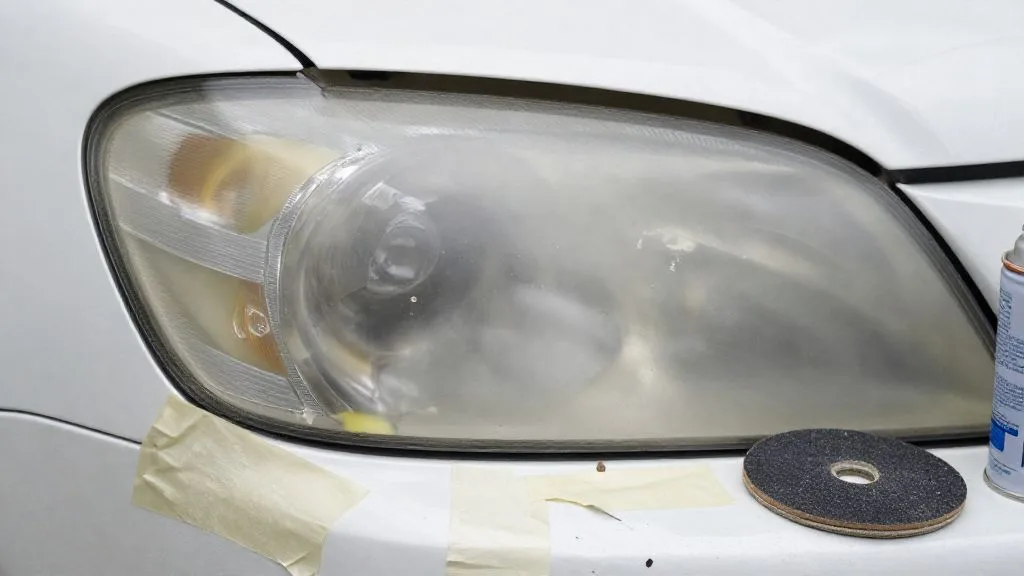
Polycarbonate lenses leave the factory with a UV hardcoat. Once that coating thins, the plastic underneath oxidizes. Most cheap kits rely on light sanding and a 1K wipe that flashes solvents but never builds a hard, crosslinked film. The result is a thin skin that scuffs in a few washes and allows oxygen and UV to sneak through.
Two-component urethane behaves differently. SprayMax 2K carries an internal hardener that chemically cures into a dense film with UV absorbers. Two coats typically measure 40 to 60 microns, which shields the plastic and resists heat. Here is the non-obvious part: polishing to a glassy finish before clear can hurt adhesion. Stop at a uniform P3000 satin so the clear can key in mechanically.
Tools, abrasives, and safety gear for a lasting refinish
You do not need a booth, but you do need the right consumables and protection. A single can of SprayMax 2K Clear Glamour 3680061 usually covers both lenses with a margin for a light third pass. The rest is about clean sanding and clean spraying.
- SprayMax 2K Clear Glamour 3680061 aerosol - 1 can per vehicle.
- Abrasives: 800, 1000, 1500, 2000, and 3000 grit. 3M Trizact P3000 foam discs help keep the scratch uniform.
- Optional tool: compact DA or drill with a soft interface pad for even pressure.
- Masking: 3M 233+ tape and masking paper or plastic sheeting.
- Cleaning: 91 percent isopropyl alcohol or PPG DX330, lint-free towels, and a tack cloth.
- Lighting: bright work light to read scratch patterns and defects.
- Respirator: half-mask with 3M 6001 organic vapor cartridges plus P100 prefilters. Nitrile gloves and safety glasses.
Trade-off: 2K urethane contains isocyanates. Spray only with real ventilation and proper PPE, never in living spaces. Overspray is sticky and travels farther than expected, so mask wide and keep other panels covered.
Step-by-step sanding to a uniform 3000 grit scratch
The target is simple: remove the failed film and oxidation, then refine to a consistent P3000 satin with no shiny patches or deep lines. Rushing here causes cloudy results later, even with perfect spraying.
- Wash the lens and nearby paint. Clay the lens if road tar or overspray is present.
- Start at 800 grit for heavy yellowing or stubborn wipe-on residue. If the lens is mildly hazed, begin at 1000 or 1500.
- Sand wet with clean water and a drop of dish soap. Use a crosshatch pattern and keep the pad flat.
- Work through 1000, 1500, and 2000. Do not advance until the previous scratches are fully replaced. Wipe dry and inspect under a strong light.
- Finish with P3000 on a foam-backed disc. Aim for an even, frosted look from edge to edge.
Edges burn through fast. Lighten pressure at corners and ridge lines. A useful check: color in a few lines with a Sharpie, then sand until the ink disappears evenly. If any glossy islands remain, the old coating is still there. Keep going at the current grit. Do not polish past 3000 before clearing, even if it looks tempting.
Masking and degreasing to prevent fisheyes and lift
Silicone, wax, and oils cause craters that never flow out. Remove them aggressively. After sanding, wash the lens and surrounding panel, rinse, and dry. Wipe the lens two or three times with 91 percent IPA or a dedicated panel wipe using fresh towels each pass. Do not touch the surface with bare fingers after this point.
Mask a generous perimeter, at least 12 inches around the lens on a 2012 Toyota Camry or similar. Tuck tape slightly under the lens edge to protect the gasket. Drape paper or plastic over the hood, fender, and bumper. Right before spraying, give the lens a single light pass with a tack cloth and lightly mist the ground to settle dust if you are outside.
Spray technique for SprayMax 2K Clear 3680061
Activate the can by snapping the red button on the bottom, then shake hard for 2 minutes. Pot life is about 24 to 48 hours at 68 F, so plan to spray both lenses the same day. Ideal conditions are 65 to 85 F with moderate humidity.
- Distance and overlap: 6 to 8 inches away with roughly 70 percent overlap. Start each pass off the lens and finish off the opposite edge.
- Coat 1: light to medium tack coat for even coverage without flooding.
- Flash: wait 10 to 15 minutes until tacky but not stringy.
- Coat 2: a fuller wet coat for gloss and build. Watch the reflection line. If it starts to snake, you are too wet or too close.
- Optional: a third light coat after another 10 minutes if coverage looks thin.
If you see dry spray or grain, you are too far or moving too fast. If you see curtains, you are too close or pausing at the edge. Small adjustments fix most issues. Do not chase perfection in the moment. A light nib sand and polish after cure can flatten minor texture.
Fixing defects like orange peel, runs, or haze
Defects happen, even to pros. The trick is waiting for the film to harden and then correcting cleanly. Resist the urge to wipe a fresh run. That only smears it across the lens.
- Orange peel: after 48 hours, level with 2000 then P3000 and lightly polish. If texture is severe, sand flat and re-spray within 24 hours, or fully cure, sand, and recoat.
- Runs or sags: let them cure. Block with 1500 on a hard interface, then 2000 and P3000, then polish.
- Fisheyes: usually silicone. Sand back to a uniform 1000 to 1500 scratch, degrease with fresh towels, and re-spray. Avoid tire shine on nearby rubber the day before.
- Milky blush: moisture trapped from wet sanding or high humidity. Warm the lens gently with moving air or a heat gun on low from 8 to 10 inches away until it clears, then recoat.
- Edge lift: leftover old coating near the perimeter. Feather with 800 to 1000 until the ridge disappears, extend the sand area a few millimeters, and re-spray.
One more contrarian point: going to 5000 grit can make orange peel less likely, but it also reduces bite. P3000 is the sweet spot for adhesion without visible sanding lines under clear.
Frequently asked questions about 2K headlight clear
Do I need adhesion promoter on polycarbonate lenses?
No. A complete 800 through 3000 grit prep provides strong mechanical adhesion. Promoter can add complexity and may tint the clear. On fully decontaminated lenses it is rarely necessary.
Can I start sanding at 1500 if the haze is light?
Yes, if the coating is not stubborn. But still finish at P3000. Skipping the final refinement leaves visible lines under the clear.
Is a 1K clear coat or UV wipe good enough for a year?
Unlikely outdoors. 1K films soften with heat and wash chemicals. Real-world results are often 4 to 12 weeks before haze returns, especially on sun-baked daily drivers.
Can I spray 2K clear in a closed garage safely?
Only with strong exhaust ventilation and an OV respirator with P100 filtration. Isocyanates are hazardous. Spraying outside on a calm, mild day is often safer.
SprayMax 2K clear cure and care timeline
Plan your first day around dust control and drying. Spray in the afternoon, then keep the surface dry for at least 12 hours. The film is dust free in roughly 20 to 30 minutes and safe to handle around 60 to 90 minutes, but overnight protection is smart if dew is likely.
Full cure typically lands between 24 and 72 hours depending on temperature. If a small dust nib bothers you, wait at least 48 hours, then level with 2000 or P3000 and give it a quick polish. Skip wax and ceramic sprays for 7 days. After that, a simple polymer sealant every 2 to 3 months keeps bugs and film from sticking.
Expect 2 to 5 years of clarity on a daily driver parked outside, with coastal sun pushing toward the shorter end. A garaged 2010 Honda CR-V can easily stay clear beyond two winters. The method is not free of hassle and the safety steps are real, but the payoff is obvious each night when your beams reach the road again.