Cold night. Wet curb. Low battery. You pull up to a public charger and the weather is throwing buckets. Is it actually safe to plug in, or should you wait it out? Here is the practical answer, without the myths.
Modern EV charging hardware is built for bad weather. The high voltage stays locked out until the car and charger complete a safety handshake, and the connectors themselves are designed to shed water. Even so, some sites are neglected, and some gear gets damaged. Your job is simple - use equipment as designed and learn the red flags.
How charging hardware keeps you safe in wet conditions
EVSE and DC fast chargers follow safety standards such as SAE J1772, IEC 61851, and UL 2202. The control pilot and proximity circuits make sure power is off until the plug is fully seated. That means you can touch the outside of the connector in the rain without the pins being energized.
Connectors like CCS1, CCS2, Tesla NACS, and CHAdeMO use molded housings with drainage paths and rubber gaskets. Most public pedestals carry an IP54 or IP55 rating, and many cabinets are NEMA 3R or 4. Those ratings mean protection against water spray, not submersion.
Ground fault protection is also built in. AC stations typically trip around 20 to 30 mA, and DC fast chargers monitor isolation continuously. If water causes a fault, the unit shuts down in milliseconds. The trade off is occasional nuisance trips during heavy storms, which is annoying but safe.
What actions are actually safe in rain or snow
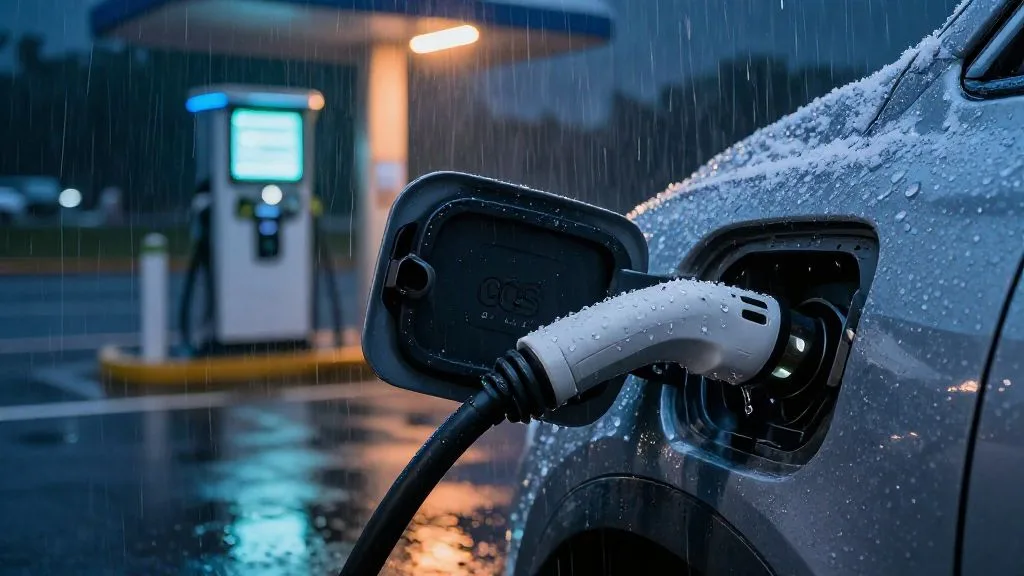
Plugging in during steady rain is fine with intact equipment. Grip the handle, aim the connector downward so water drains, and seat it firmly until you hear or feel a click. Start the session by app, card, or screen as usual. Power will only flow after the handshake completes.
Light snow is more cleanup than risk. Brush off the port door, the connector face, and the latch. If ice blocks the latch, warm the handle in your gloved hands or inside the cabin for 2 to 3 minutes and try again. Do not whack a frozen latch - impact can crack the housing.
- Avoid standing in deep puddles near energized equipment. A shallow wet surface is fine, but skip a charger surrounded by ankle deep water.
- Wipe visible water from the connector face if pooling. A simple shake works.
- If the station trips immediately, stop and move to another unit. Repeated trips signal a fault, not user error.
- For overnight Level 1, use a dedicated outdoor outlet with a weatherproof cover. Never run a household extension cord through snow.
Red flags that make a station risky
Some problems you can spot in seconds. Others you smell. Trust both. If you see any of the following, skip that handle and report it to the network or host.
- Cracked connector housing, missing gasket, or a latch that will not spring back.
- Discolored or pitted pins - brown or blue tint suggests heat damage.
- Visible cuts in cable insulation or exposed braid. Even a 1 cm nick is a no go.
- Water trapped inside the connector face. If you tilt it and water pools, do not use it.
- Cabinet doors ajar, missing bolts, or fans cycling with loud scraping. That points to water ingress.
- Screen shows repeated ground fault or isolation errors. Three trips in a row is enough to walk away.
One more sign that is easy to miss - heavy salt crust around the pedestal base. Salt plus meltwater creeps into enclosures. Corrosion often follows. Choose a different stall if you can.
Cold weather behavior that looks scary but is normal
Cold packs charge slower. Below about 10 C, most cars limit current to protect the cells. At -10 C, you might see 20 kW on a 150 kW charger until the pack warms. This can last 5 to 15 minutes.
Preconditioning helps. Tesla, Hyundai Ioniq 5, and Porsche Taycan can heat the battery on the way to a charger. Expect 3 to 7 kW of heater load, which briefly reduces net charge power. You may also hear contactors click and see steam rise from a wet cable - that is just warm insulation meeting cold air.
Cables stiffen in deep cold. CCS and CHAdeMO handles can feel stubborn. Do not twist aggressively. Keep the connector straight and support the cable with your forearm to avoid stressing the latch.
Quick checks before you plug in - a 30 second routine
This short scan catches most problems fast.
- Look at the handle face and pins. Clean, no cracks, no standing water.
- Run your finger around the gasket. It should be seated and springy.
- Check the cable jacket for cuts. A light scuff is fine, a slice is not.
- Sniff near the connector. Burnt plastic smell means skip it.
- Confirm the screen shows ready, not fault. If the UI is dead, try another stall.
- Step away from deep puddles. If water covers the pedestal base, choose a different unit.
If the station label lists IP54 or NEMA 3R, it is intended for outdoor use in rain. Submersion is outside the spec. Use common sense in floods.
What protection actually prevents shock
On AC, J1772 equipment integrates ground fault protection per UL 2231 and SAE J1772. It trips around 20 to 30 mA, far below dangerous levels. On DC, isolation monitoring ensures the high voltage path stays insulated from chassis ground per IEC 61851 and ISO 17409.
The handshake logic is your guardian. Until the car signals that the connector is fully seated and safe, the contactors remain open. You can splash the outside of the handle without energizing anything. This design is why wet weather charging has an excellent safety record.
Trade off time - sensitive protection can shut sessions down during extreme spray or cable damage. That can waste minutes on a road trip. The safer move is to switch stalls rather than fight a tripping unit.
For site hosts: keeping outdoor stations dependable
Plow patterns matter. Keep snow berms and meltwater away from pedestals and cabinet vents. Leave at least 1 meter of clear space so drivers can route the cable without dragging it through slush.
Inspect gaskets, latches, and strain reliefs each quarter. Replace cracked handles immediately. A $250 handle beats a cabinet repair after brine works its way in.
Use NEMA 4 enclosures for coastal or heavy-spray sites and consider drip shields above pedestals. Verify torque on terminal blocks annually - thermal cycling can loosen hardware.
Finally, keep a dry spare handle kit and contact cleaner on site. Fast swaps reduce downtime during storms.
FAQ: short answers for awkward weather questions
Can you charge during a thunderstorm?
Yes, the equipment can operate in rain with lightning in the area, and surge protection is built into most DC cabinets. Still, if lightning is striking nearby and you feel unsafe, wait in the car and start the session remotely through the app if supported. If power flickers, expect interrupted sessions.
Is it safe to plug in if the connector is dripping wet?
Yes, as long as the connector and port are intact. Shake off obvious water and plug straight in. The pins are not energized until the handshake completes, and the gasket blocks spray.
What if the charge port is packed with ice?
Do not force the plug. Run cabin heat for 5 to 10 minutes or use a warm cloth. Avoid de-icer sprays that attack rubber - some solvents swell gaskets. If the latch will not close, move on.
How cold is too cold to fast charge?
Cars can charge below -20 C, but power ramps slowly. On 800 V platforms like Hyundai E-GMP, you might see 30 to 60 kW until the pack reaches around 15 C. Preconditioning via navigation helps a lot.
Can I use a household extension cord for Level 1 in snow?
No. Most cords are not rated for continuous 12 A in wet areas. Use a dedicated outdoor GFCI outlet with an in-use cover and a manufacturer-approved cord set only.
Final tip for winter road trips
Pick sites with overhead canopies or wall mounts when the forecast looks rough. The difference between a dry handle and an ice-caked one is real time - sometimes 10 minutes saved at each stop. Start preconditioning 20 minutes before arrival, and favor stations listed as 150 kW or higher so you still get decent speed after a cold ramp. Small habits make wet weather charging feel routine.